Solomon Islands’ first surgeon to train in US brings visions of collaboration to Brown
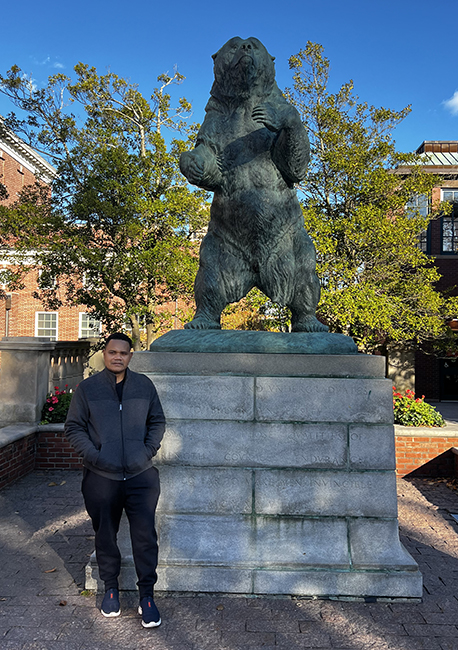 On a chilly October day, Stallone Kohia, MMed, found himself thousands of miles away from his tropical Pacific home in Solomon Islands. It was his first experience with truly cold weather in America, visiting New York City and later venturing to Brown University and The Warren Alpert Medical School, in what was a professional and personal pilgrimage for Solomon Islands’ first surgeon to train at a US-based hospital.
“It’s a bit cold for me in New York, but I’m getting used to it,” Kohia says. “I love the place.”
Kohia understands well the importance of his time in the US. With no medical school in Solomon Islands and unique challenges like a lack of infrastructure and clinicians, his time training here is a way to open new doors for himself and others.
He began training at the Memorial Sloan Kettering Cancer Center in September, then came to Brown in late October to deliver a lecture about H. pylori and gastrointestinal diseases as part of the Paul J. Galkin Global Health Grand Rounds.
“I think it’s a very big boost for someone like me to practice in a setting that is far different from [Solomon Islands],” Kohia says. “I know it’s going to be a long way to establish a medical school, but we have the opportunity to collaborate and set up academia back home.”
His connection with American researchers grew from his friendship with Dylan Bush MD’27, who first visited the islands as an undergraduate at the University of California, Berkeley. . What started as a semester abroad experience grew into a long-term commitment in the country: Bush’s research into diabetic amputations provided a springboard for the creation of a national strategy to manage diabetic limb infections by Solomon Islands’ Ministry of Health, in partnership with the World Health Organization. In fact, Bush helped Kohia apply for the Mammadi Soudavar Fellowship, a fully funded training observation program at the Memorial Sloan Kettering Cancer Center for surgeons from low- and middle-income countries.
Kohia recalled that in 2022, while preparing to go to Papua New Guinea for his surgical training, he visited the National Referral Hospital, in the capital of Honiara. As the nation’s only tertiary care center, it was an ample opportunity to explore potential research partnerships as part of his training, he says.
“I popped into the residents’ room and saw [Bush] there,” Kohia says. “He spoke pidgin—and fluently, too—so that definitely caught my attention.”
The two bonded over their research, and over the coming weeks as they continued speaking about Solomon Islands and some of its ongoing medical challenges.
“From our first meeting, it was clear that Stallone brings exceptional enthusiasm and a sustained commitment to improving medical care in the Solomon Islands. His accomplishments are not only a testament to his strong work ethic, but also a compelling example of the impact that can be achieved when we invest in local physician-researchers,” Bush says. “While I have valued my experience working to document and describe disparities in surgical care in Solomon Islands, local clinicians like Stallone are the true experts on the needs of their patients.”
Their bonding culminated in a research paper published in Science Progress that examined the state of gastrointestinal disease in Solomon Islands and potential clinical pathways for expanding endoscopy to patients nationwide. It was the first study of its kind in the country, Kohia says.
“Part of the issue is that, beyond not having many researchers or clinicians, there aren’t many incentives to push global research here,” Kohia says. The nation is also reliant on surrounding countries like Australia and New Zealand for testing supplies and equipment, and there is a lack of miniscopes for endoscopic procedures.
His talk at Brown highlights the issues clinicians face in Solomon Islands, and reflects the need for continued collaboration between smaller nations and global health researchers at large. During his October visit, Kohia met with Dean of Medicine and Biological Sciences Mukesh K. Jain, MD, about cultivating such relationships in the hope of one day building a clinical foundation that could lead to the islands’ first medical school.
“There are doors opening and they’re not just for me,” Kohia says. “We also have younger doctors that are coming up behind me, and seeing me come this far is motivation for them. This international collaboration plays such a big role in terms of mentorship and research, and these discussions can only ever impact us in a positive manner.”