Untreated obstructive sleep apnea may worsen outcomes for glioblastoma patients, Brown study finds
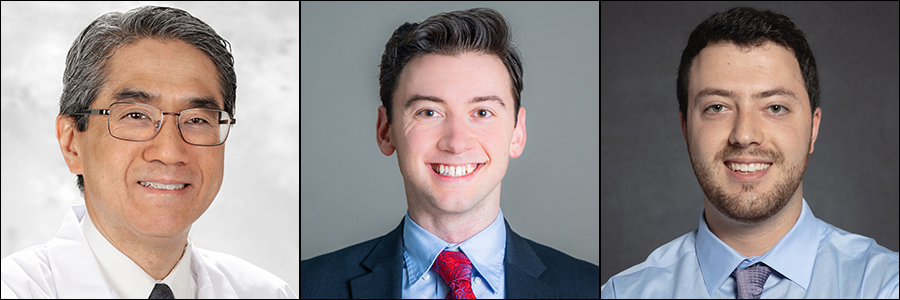
The risk of death for glioblastoma patients who are likely suffering from undiagnosed sleep apnea is significantly higher than for other patients, according to a new study in the British Journal of Cancer Reports led by two medical students at Brown.
Justin Bessette '22 MD'26 and Jonathan Arditi '22 MD'28 reviewed the records of nearly 1,000 patients admitted to Rhode Island Hospital between 2005 and 2022. Beyond demonstrating that age and the number of medical conditions heavily influence survival rates, the retrospective study revealed that the risk of death is at least three times higher for those suffering from obesity and atrial fibrillation.
The student researchers hypothesized that underlying, untreated sleep apnea—which is closely associated with both obesity and atrial fibrillation—is the true culprit behind these worsened outcomes. Sleep apnea is already associated with a host of health problems like diabetes, stroke, and respiratory failure.
“Quite a lot of research has been done on the tumors themselves, but researchers have not focused on the environment outside of the tumor, particularly co-morbidities that are lurching in these patients,” says Eric T Wong, MD, professor of neurology, medicine, neurosurgery and radiation oncology.
Bessette says the study initially focused on analyzing the connection between patients’ history of cancer and glioblastoma outcomes, but they found a complex web of medical comorbidities among them.
“There were all of these patients who had so many other things going on other than cancer, so I got the idea that maybe there are other conditions affecting the survival rates in them,” he says.
Bessette says it was a major undertaking for nearly two years, as they examined everything from hypertension and heart conditions to psychiatric disorders. His friend Arditi entered the picture when it came time to do a deeper statistical analysis on the correlation between some of the specific factors and survival rates.
“I wanted to look at pairs of comorbidities and examine how survival rates change versus having both or only one,” Arditi says. “That’s how we began to discover the relationship between obesity and atrial fibrillation among patients, and the implication for sleep apnea.”
Arditi says they utilized different models to examine comorbidities, including the Charlson Comorbidity Index (CCI), which can predict the 10-year survival rate in patients with multiple health conditions. However, due to the heavy influence of age in determining patient survival scores, the team removed age from their calculations and found that the index doesn’t actually capture an outlook robust enough to account for comorbidities that could potentially play a greater role in survival.
“By taking age out of the equation, [Arditi] showed that CCI was still predictive of survival but to a far lesser extent,” Bessette says. “Therefore, there might be more prognostic comorbidities out there and we could be looking to create a more specific tool to calculate those survival rates better.”
This dataset also demonstrated how metabolic diseases, like hypertension and type 2 diabetes, are deeply intertwined with survival rates, Wong says. Patients suffering from obstructive sleep apnea may have these two underlying conditions as well, showing a greater need to understand patient survival rates beyond traditional models like CCI.
“I was very grateful that we had Dr. Wong’s clinical insight, and Justin has a lot more clinical knowledge than I do, so they were very accommodating of my crazy ideas,” Arditi says.
Wong says the fact that both Bessette and Arditi are first authors on this paper speaks volumes of their dedication to research. They’re hoping to validate their findings further with a new dataset at another institution, and perhaps even construct a clinical trial to test the hypothesis that correcting obstructive sleep apnea may prolong survival. The door remains open for other students to work with the established dataset and examine other comorbidities or ongoing treatments in detail.
“This was pushed forward by two extremely talented and hard-working PLME students,” Wong says. “Effort does not guarantee that you will have groundbreaking results, but if you don’t put in the effort you won’t get any results.”