Nine years ago, Chathuraka Jayasuriya PhD’13 received a Pilot Project grant from Advance Rhode Island Clinical and Translational Research, a vote of confidence in the budding researcher by the NIH-funded initiative, which trains and supports investigators across the state.
Now, after nearly a decade building on that success, Advance RI-CTR has recognized him again with its inaugural Award for Clinical and Translational Research Excellence.
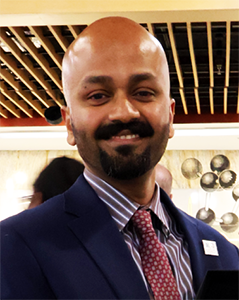
“I’m really honored to receive it,” Jayasuriya, an associate professor of orthopaedics, says of the $10,000 prize, which will support his efforts to develop a stem cell-based therapy for meniscus tears, a common knee injury. “I don’t think we would be where we are without Advance RI-CTR,” he adds.
“Dr. Jayasuriya is the embodiment of what Advance RI-CTR was designed to achieve—taking an idea from the lab bench and accelerating it toward patient care,” says Sharon Rounds, MD, program director of Advance RI-CTR. “His journey, which began with one of our earliest Pilot Project awards, validates a decade of strategic investment in Rhode Island's brightest minds.”
Advance RI-CTR was formed in 2016 with a grant from the National Institute of General Medical Sciences. It provides resources and services to clinical and translational scientists at the University of Rhode Island, Care New England and Brown University Health hospitals, and the Providence VA Healthcare System, as well as Brown, where the group is based.
Jayasuriya and Professor of Orthopaedics Brett Owens, MD, received a Pilot Project award later that year to investigate whether mesenchymal progenitor stem cells, which derive from healthy joint cartilage, could be injected into the knee to repair meniscus tears—and reduce the risk of developing osteoarthritis.
That initial funding catalyzed their research program, as they moved from proof-of-concept studies to research demonstrating the biologic therapy’s safety and efficacy in rats and then pigs. The technology also evolved over the years, Jayasuriya says: “Instead of just injecting cells, we’re combining the cells now with a scaffold”—a biomaterial used in meniscus repair—“that assists with the healing process.”
Jayasuriya’s team has received several more grants, including one from the Department of Defense in 2020. “The DOD realized that it’s significant research, that this is something that needs to be done,” he says. Then, in 2023, they won an NIH R01 grant, which is allowing them to test the therapy in more animals, in females as well as males, and to study its long-term efficacy.
The goal of the current study, Jayasuriya says, is to obtain safety and efficacy data required by the FDA to greenlight clinical trials in human participants. But, with venture capitalists already showing interest in investing in the technology, he and his former postdoc, Jay Trivedi, PhD, now an assistant professor of orthopaedics (research) at Brown, cofounded a start-up, EnkaBio Inc., this fall. Just weeks later, they received a $35,000 grant from the Rhode Island Life Science Hub to build out the company. Owens is EnkaBio’s primary clinical adviser.
“We’re really happy that those are the first dollars that are coming into the company,” Jayasuriya says. “Rhode Island is becoming quite the ecosystem that nurtures life sciences innovations, and we plan to place our roots here.”
None of this would have been possible, he adds, without that early boost from Advance RI-CTR. Jayasuriya notes that only with federal funding can researchers translate basic discoveries in the lab into therapies or technologies that improve patient care.
“When it comes to developing any innovative treatment or therapy, there’s a stage called the infancy stage where you’re still learning. Companies typically don’t want to invest at this early stage because there are so many risks,” he says. “If the RI-CTR didn’t take a chance on us giving us the opportunity to test and derisk our technology, we would never have gotten off the ground to do the rest. We would have never known that these cells would be effective for this purpose.”
Jayasuriya hopes—if the FDA gives them the go-ahead for clinical trials, and the trials succeed—to be able to deliver their therapy to patients within seven years. “If we’re successful, we stand to improve the lives of a lot of people,” he says. “I see this as being the ultimate reason for why I got into science. And I’m not going to stop until we can get this technology out to patients and treat these injuries better.”