For the Kinnaman clan, Direct Doctors is, truly, a family practice.
Andrew Kinnaman goes to the East Greenwich medical office to see Mark Turshen, MD, for routine check-ups and, occasionally, orthopedic issues. Stephanie Kinnaman sees Lauren Hedde, DO, for her women’s health needs and chronic ear infections. The infections have demanded frequent care and, eventually, required a referral to a local ear, nose, and throat specialist, who performed surgery for a burst eardrum.
The three Kinnaman kids—10-year-old Will, 7-year-old Jonathan, and 5-year-old Lydia—also see Hedde. Jonathan and Lydia have received all their medical care from this Brown-trained physician, who made house calls to North Kingstown when they were born.
“Dr. Hedde is willing to take the time,” Stephanie Kinnaman says. “She wants to understand my concerns. And if she doesn’t know something, she looks it up—then follows up. Our relationship feels like a partnership.”
The ability to form strong, long patient relationships is a defining feature of family medicine—a kind of primary care that involves comprehensive care for people of all ages. Family physicians can care for someone for their lifetime—cradle-to-grave, as some like to say—then go on to care for their children and grandchildren and even great-grandchildren. It’s intimate work that, doctors and patients report, can be deeply gratifying.
Family physicians also provide an astounding array of care, from routine check-ups to preventive screenings to chronic disease counsel. In a single day, a family physician can treat a newborn’s diaper rash, inject a runner’s knee to relieve inflammation, and guide a grandpa through options for treating his high blood sugar to prevent the diabetes he’s increasingly at risk of developing.
These doctors are medicine’s people-focused, mission-driven utility players, able to form lasting bonds with patients, improve public health, and treat all ages and many conditions. For this reason, they are in high demand and short supply in Rhode Island and across the country as access to primary care shrinks to crisis levels.
The Warren Alpert Medical School of Brown University has improved both primary care access and quality for two generations. In 1975, the school launched its family medicine residency program—the first in the Ivy League. The program to date has trained more than 600 family medicine specialists, and almost half of them stayed in Rhode Island to practice. Over the last 50 years, these specialists have provided essential, routine care for hundreds of thousands of Ocean State residents, saving, lengthening, and improving lives.
In addition to increasing access to primary care in Rhode Island, Brown’s family medicine leaders have improved the quality of that care. Some examples:
● Joining several landmark research studies, such as the Women’s Health Initiative extension study, that have changed how primary care is practiced or has influenced public health and primary care policy
● Launching or participating in clinical trials that give Rhode Islanders access to leading-edge drugs, tools, and care models used to treat illnesses such as pneumonia and asthma often seen in primary care practices
● Advancing medical education not only for Brown-trained physicians but all physicians through efforts like Aquifer, an online clinical learning platform whose academic director is the Medical School’s David Anthony, MD
● Advocating for quality primary care at the state and national levels through organizations such as the Rhode Island Academy of Family Physicians and events such as the annual Family Medicine Advocacy Summit, where members lobby Congress for pro-primary care legislation
● Bringing fresh ideas and the latest evidence-based practices to primary care physicians here and around the world through the Annals of Family Medicine, the peer-reviewed, open-access journal based at Brown
● Donating hundreds of hours of volunteer time to community clinics in high-need areas like Pawtucket, Central Falls, and Providence.
Brown leaders are continuing to address the primary care crisis in Rhode Island, efforts that will not only improve health in the Ocean State but help residents save money by avoiding the expense of urgent care clinics, emergency rooms, and hospitals.
“It’s hard to overstate Brown’s influence,” says Caroline Richardson, MD, chair of family medicine and the George A. and Marilyn M. Bray Professor of Family Medicine at Brown. “The university and its medical school make a profound, positive impact on family medicine in Rhode Island and all primary care in the state.”
THE WORK
After medical school, newly minted doctors go through an intensive training program called a residency. This is when physicians start to specialize by getting hands-on experience in their area of interest, from dermatology to surgery. Family medicine residents typically spend three years in hospitals and clinics to learn about their broad spectrum of practice from front-line physicians, as well as researchers, advocates, and policymakers.
Brown’s family medicine residency is one of the oldest in the country, and rotates its residents through The Miriam Hospital, Women & Infants Hospital, Kent Hospital, and Hasbro Children’s Hospital as well as community clinics that include the Family Care Center in Pawtucket and Thundermist Health Center in West Warwick.
It’s in residency that family medicine physicians dive into the abundance and variety of their work: cardiology; dermatology; ear, nose, and throat medicine; emergency medicine; internal medicine; obstetrics and gynecology; ophthalmology; orthopedics; pediatrics; sports medicine. And, of course, family medicine.
Here are snapshots of three graduates of Brown’s family medicine residency program.
Thomas M. Atwood, MD
Practice: Care New England Medical Group
Motivation: “I get to build relationships with patients over an extended period of time. And I like the goal of primary care, which is to keep people healthy and prevent disease.”
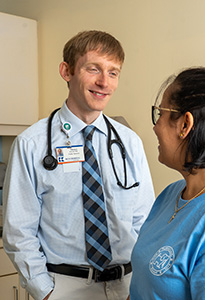
Tom Atwood, MD, has a three-part practice. At The Miriam, he treats people with conditions that are swift and serious, like a heart attack or pneumonia. At the Family Care Center, he helps patients manage long-term illnesses like congestive heart failure. For The Warren Alpert Medical School, he teaches medical students and supervises family medicine residents at The Miriam and Kent hospitals.
The Family Care Center, a major training site for Brown family physicians, attracts a broad mix of patients, mainly from Pawtucket, Central Falls, and Providence, and because of the primary care crunch, even draws patients from Massachusetts and Connecticut. Many are older and speak languages other than English; some lack transportation or social support.
Atwood loves this work—despite the red tape from the insurance companies, the understaffing, the large patient roster, and the short patient visits. He recalls that, as a resident, he saw a young girl in the hospital and diagnosed her type 1 diabetes; then, as a physician, he helped her manage her disease into adulthood and care for the rest of her family. Atwood also has diabetes, and the support he received from his doctor was a major reason he got into medicine.
“In family medicine, we get to put the whole person—not just their disease—in the forefront of our work,” Atwood says. “That is the great joy of the practice.”
Matthew T. Salisbury, MD
Practice: Brown Health – Cranston Primary Care
Motivation: “I like doing it all, and in family medicine, anything you want to do, you can. I also like the longitudinal relationships with patients. We don’t move on. You’re with people for decades.”
Cranston Primary Care is big, busy, and growing. Just this year, the practice added three new primary care providers, bringing the total to eight. Matt Salisbury, MD, estimates that when the family medicine team gets up to full speed, they’ll serve up to 15,000 patients. Demand, Salisbury knows, is high.
“I started with about 1,500 patients and now I’ve got 2,100,” Salisbury says. “So many people need primary care. Everyone has a waiting list.”
Cranston Primary Care is located in the Garden City neighborhood, and it serves just about everyone, from low-income children and seniors covered by government health insurance to the independently wealthy who pay for their own care. Salisbury says that, overall, the clinic reflects Cranston—mostly middle-class families who get health insurance from their employer.
A non-traditional student who entered medical school at age 30, Salisbury originally wanted to specialize in cancer care. Then he did his family medicine rotation and got hooked. He’s been in practice for 22 years and it’s the people-centered mission that keeps him in. Salisbury has one family he cares for across four generations, from the great-grandma with dementia and congestive heart failure to the infant great-grandchild who is perfectly, happily healthy.
“The goal of primary care is to keep people healthy,” he says. “You get to do a fair amount of prevention in family medicine, and over time, that allows you to take better care of your patients.”
Cristina A. Pacheco, MD
Practice: Blackstone Valley Community Health Care
Motivation: “I wanted to be a patient’s top advocate and give them the good news and the bad news—all of it. And when I met other family practice physicians, I knew I’d met my people. I was home.”
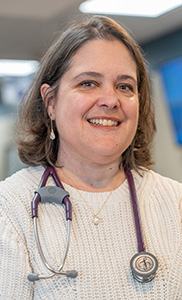
Cristina Pacheco, MD, is a rare Brown bird. She was a pre-med student at Brown, attended medical school at Brown, and did her residency at Brown. She even met her husband at the university. For her, Brown and family medicine have the same pull. It’s the people.
“There’s an intimacy to family medicine,” she says. “You’re there for people in a time of need. You see them when they’re vulnerable and it’s your job to keep them safe. It’s a privilege to be the person a patient turns to, again and again.”
One of those people is Lisa Hicks, a 48-year-old Brown graduate and online high school teacher who started seeing Pacheco as a patient at Blackstone Valley five years ago. It was a dramatic introduction. Hicks had just moved to Providence and had menstrual bleeding for weeks. Was it a normal symptom of perimenopause? Pacheco ordered imaging and blood work, found that fibroids were the culprit, and got Pacheco quickly in for a procedure.
“I’m extra lucky that if I tell Dr. Pacheco something is happening, she believes it is happening,” Hicks says. “I feel seen. I feel heard. There’s trust, on both sides.”
Pacheco started as a physician at Blackstone Valley Community Health Care in 2013, then moved up to chief medical officer in 2018, a position she held until 2023. After a few months away, she returned—then got promoted to chief executive officer last year. Blackstone Valley is a Federally Qualified Patient-Centered Medical Home, a model of primary care that provides comprehensive, coordinated care to the underserved. At Blackstone Valley, patients not only get medical care, but eye care, dental care, and mental health care. The practice is one of the few in Rhode Island accepting new patients—sometimes even seeing them the same day—and is expected to see up to 24,000 people this year.
“There’s exhaustion in the job—and frustration,” Pacheco says. “There’s a lot of paperwork and cost-cutting measures from insurance companies. And there’s moral injury. We’ve seen people in our community arrested by immigration officials or living with 10 people in a two-bedroom home. This job is tough. And I wouldn’t do anything else.”
THE FUTURE
The lack of primary care is a national crisis, one that many forces created. Fewer medical students nationwide are choosing family medicine or the other primary care specialties of internal medicine, pediatrics, and obstetrics and gynecology. Burnout rates are high while service payments from insurance companies and the government are low.
Then there’s prior authorization. Insurers require doctors to go through this process before they approve payment for certain drugs, tests, surgeries, or equipment. Prior authorization can take pages of forms and sometimes months to complete and is universally despised by doctors and patients. In 2024, the American Medical Association released results of their national annual survey of 1,000 physicians that showed that nine in 10 believe prior authorization leads to negative patient outcomes, including 78 percent who reported that the process often or sometimes results in patients abandoning treatment altogether.
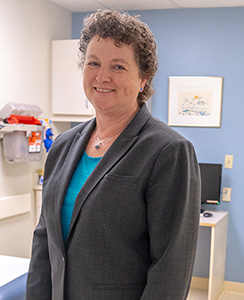
In Rhode Island, practicing primary care is particularly challenging. According to a report commissioned by the Rhode Island Foundation and released in 2024, Rhode Island health care workers are generally paid less compared to neighboring Connecticut and Massachusetts. The provider shortage is accelerating burnout, which is driving out providers and creating a downward spiral for doctors and patients alike. The Rhode Island Medical Society reports that since 2024, at least 29,500 state residents have lost primary care access due to practice closures. The issue is not unique to Rhode Island, however; the National Center for Health Workforce Analysis predicts a national shortage of 87,150 primary care physicians by the year 2037.
The urgency of the situation has the attention of state leaders, who not only see primary care access as a health issue, but as an economic issue. Businesses—and their employees—don’t stay in places where it’s hard to get medical care.
This spring, Rhode Island Attorney General Peter Neronha introduced a series of actions to help primary care providers, including introducing legislation to raise reimbursement rates and to eliminate nearly 100 percent of prior authorization requirements. Legislators passed the prior authorization bill in June. That same month, legislators put over $40 million in the state budget to increase reimbursement rates for primary care providers who serve patients on Medicaid, the health insurance program for people with low incomes. In October, Neronha’s office used its antitrust authority to require that Brown University Health, as a condition of merging with Brown Physicians, Inc., increase access to primary care for 30,000 new patients over a three-year period, and potentially increase to 40,000 new patients over four years.
Rhode Island Gov. Dan McKee has taken additional steps to improve primary care access. According to Kerri White, spokeswoman for the state’s Executive Office of Health and Human Services, the McKee administration has:
● Created a grant program for primary care providers, which offers one-time funds of up to $300,000 to practices that serve more patients, add providers, or start serving Medicaid patients
● Put in effect new regulations that require health insurance companies to increase payments to primary care providers, with a goal of doubling their primary care spending by 2029
● Launched the Primary Care Training Sites program through the state Department of Health, which gives grant funds to practices that train and mentor more physicians, nurse practitioners, and physician assistants
● Used the structure of the state Health Care System Planning Cabinet, formed in 2024, to create a Primary Care Crisis Team to deliver urgent reform.
“Here in Rhode Island, we know that a strong primary care system helps build strong communities,” McKee says. “That’s why we continue to invest in both short- and long-term strategic actions to strengthen our primary care—including expanding the primary care student loan forgiveness program and providing grants to help primary care practices serve additional patients and hire new providers.”
Change is not only coming from the top down, but the bottom up.
When Lauren Hedde opened Direct Doctors in 2014 in Wickford, it was the only office in Rhode Island that offered direct primary care, a model based on individual member fees, instead of insurance, that offers unlimited access to physicians. Today, Direct Doctors is in East Greenwich, with a satellite office in East Providence, and serves over 2,000 patients. According to the advocacy group DPC Frontier, similar practices can be found in Wakefield, Jamestown, and Warwick.
Atwood, Salisbury, Pacheco, and other Brown residency grads have their own ideas for solving the primary care crisis, including paying physicians and support staff more money to forgiving the student loans of residents pursuing primary care specialties to simplifying digital medical record notation.
Richardson, the Brown chair of family medicine, says the Medical School and its affiliated health systems are developing a plan to double down on investment in primary care training and access.
Components of the proposals include increasing the number of primary care residency slots, providing an accelerated three-year medical school curriculum, and expanding access to loan repayment options. The plans would reinforce efforts from leaders in state government and insurance companies to make primary care more sustainable for Rhode Island physicians.
“There is no single solution to the crisis we’re in,” Richardson says. “Getting more family medicine and other primary care doctors working in our state will require many different efforts by many different actors. The good news is that, right now, we’re all focused on solutions.”
Wendy Lawton is a communications strategist with Con Brio, a consulting company she founded to help nonprofits tell their stories, show their value, and meet their goals. She lives and works in South Dartmouth, MA.