The immunosuppressant drug rapamycin has received intense interest because it appears to have anti-aging effects, extending lifespan in mice and other organisms. Rapamycin is also used to treat some cancers and targets the protein mTOR, a key regulator of growth and metabolism. While mTOR is central to tumor formation, cancer therapies that broadly target mTOR have had limited success.
But according to new research led by a physician-scientist at Brown, inhibiting just one function of mTOR—its critical role in communication between cells—could yield safer, more effective drugs for many cancers.
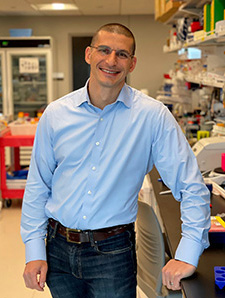
Martin Taylor, MD, PhD, an assistant professor of pathology and laboratory medicine at Brown, was the first author of the multi-institutional study. The paper, which was published in Science on Thursday, Nov. 27, freezes the action between the mTOR complex known as mTORC2 and its most important target, Akt, another protein that is heavily involved in cancer signalling and commonly mutated in cancer. This allowed the researchers to see specifically how mTORC2 recognizes its targets, including Akt, and suggests a path to new cancer treatments—something the team is already working on.
Taylor, who joined Brown’s faculty in 2024, is affiliated with both the Center on the Biology of Aging and the Legorreta Cancer Center. He discussed the new research in an interview shortly before Thanksgiving.
Congratulations on the publication of this paper.
Thank you. It's been almost seven years, a huge team and project, and it’s incredibly exciting to share these discoveries. We are excited to share this story both because we were able to answer a number of open questions that are important in basic biology and have therapeutic implications, and also because a new method we developed to trap the mTOR kinase with its Akt target, which could be useful in other cases.
How would you explain your work to any non-scientists at Thanksgiving dinner?
Cells talk to each other and sense their environment using protein networks called signaling pathways. The more important a pathway is for cell survival, the more likely cancer cells are to hijack it. The most commonly altered pathway in cancer is the PI3K–mTOR–Akt pathway, and at the center of this pathway is a protein called mTOR. mTOR is a kinase, which passes messages inside the cell by modifying target proteins. What makes mTOR unusual is that the same protein is the working engine of two different complexes, called mTORC1 and mTORC2, and each complex does something different.
mTORC1 senses nutrients like amino acids. It’s studied heavily in aging because mTORC1 determines whether the cell has enough “food.” mTORC2 responds to growth signals like insulin, and this side of mTOR is especially important in cancer. Even though mTORC1 and mTORC2 share the same core protein mTOR, they behave differently—like having one kitchen machine that can make either ice cream or pie filling depending on how you set it up (Happy Thanksgiving!).
Because the two complexes have such different jobs, we need drugs that can selectively block only one of them. But that’s tough: most drugs that hit mTOR shut down both complexes at once. This is a problem for cancer therapy. When you shut down mTORC1, the nutrient-sensing complex, cancer cells act like they’re starving. Instead of dying, they switch into a survival mode that makes them more resistant to chemotherapy. That means drugs that block both complexes at once don’t work very well for cancer therapy.
However, if we could block only mTORC2 and shut down growth signals, without touching mTORC1, we could make much better cancer treatments. To figure out how to do this, we set out to understand exactly how mTORC2 works and how mTOR behaves differently in nutrient signaling versus growth-factor signaling. This helps point the way toward designing drugs that target the cancer-relevant side of the pathway without triggering survival pathways that protect the tumor.
Are there particular cancers this would affect?
It's such a central pathway in how cells communicate that virtually all cancers have alterations in this pathway, either directly or indirectly.
Another outcome of this study is this new technique that other scientists will be able to use in different ways.
Yes, we designed a type of molecular probe to trap mTORC2 in action, and the strategy we used is applicable broadly. There are hundreds of signaling proteins in the cell, including more than 500 proteins called kinases, like mTOR, which phosphorylate targets. To trap mTORC2 phosphorylation in an intermediate state, we attached a drug—a small molecule inhibitor—to mTORC2’s most important target, Akt, at the very same position that mTORC2 would normally phosphorylate. The linkage is designed to mimic mTORC2 activating Akt as closely as possible, so mTORC2 would be frozen in action. Our Akt-Torin probe then let us determine the structure of mTORC2-Akt-Torin together and understand what features of Akt are recognized by mTORC2. The success of this strategy - the way we designed this probe to trap a kinase recognizing its target - is a new general method that other scientists could apply to any of those hundreds of signaling proteins and kinases in the cell, to understand how they recognize their targets.
How do your findings build on previous research in the field?
This entire field of investigation comes out of basic curiosity, starting from trying to figure out how rapamycin works— leading to the discovery of mTOR 30 years ago and mTORC2 20 years ago. We are standing on the shoulders of many giants.
Our strategy to trap mTORC2 using the Akt-Torin probe also comes out of decades of work. Phil Cole, last author on this study, has been a champion of this kind of rational drug design for most of his career, designing bespoke probes to fit enzyme active sites. The chemical strategy we used to specifically attach Torin to just one amino acid out of the 480 that make Akt, called “expressed protein ligation,” is something Phil co-invented with Tom Muir in the 1990s. The ability to use this technique with Akt and the underlying understanding of Akt function came out of work led by Nam Chu in Phil’s lab. Also, the custom Torin drug we used to make Akt-Torin, synthesized in Nathaniel Gray’s lab by Brian Groendyke, comes out of a collaboration between Sabatini and Gray labs that resulted in the Torin drugs and commercial mTOR inhibitors. Finally, mTORC2-Akt is a really large protein complex, and many specific tools were needed to study the complex’s structure by cryo-electron microscopy and model it.
Because this study brings together many different fields, it required a huge and extremely talented team, too many to thank in one place—co-lead authors are students Maggie Chen and Matthew Hancock (both now recently graduated), and postdoctoral fellow Maximilian Wranik. Co-senior authors are professors Kacper Rogala and Nam Chu.
What are the next steps in your research?
The most exciting next step is that our new structural understanding could allow us to make new cancer drugs that target mTORC2 specifically. mTORC2 seems to be a central node—there may be no for the cell to get around the blockade. The proof will, of course, be if we can make such a drug and test it, which has never been done.
Is that something that your team would do?
We're really interested in doing that. The first steps are to develop specific tests that could be used to screen drugs, both computationally and from libraries. We're working on that now.
You’re also an attending gastrointestinal pathologist with Brown University Health. How does your clinical work inform your research?
In pathology, we are constantly reminded of the many deficits present even in world-class cancer care. My dual role enables me to find key problems and translate discoveries quickly to the clinic, and I focused on targeting mTORC2 after seeing many metastatic pancreatic and colon cancers where no targeted therapies were available.
My science has also changed my clinical lens in thinking about carcinogenesis. I see a lot of pre-cancers and early-stage cancers, and I think a lot about cancer development and how to find it earlier or prevent it. My other scientific passion is transposons, the virus-like parasites that have written around half of the human genome. There, we're working to understand how the transposon LINE-1 contributes to cancer development. It also appears to contribute to unhealthy aging, and we have begun to translate LINE-1 insights into the clinic for two applications - first for cancer diagnosis, and second, along with two other leading scientists at Brown, John Sedivy and Bess Frost, we are developing new therapies for cancer, neurodegeneration, and aging. Although mTOR and transposons sound very different, we use similar technical approaches in both cases, and we're working on them because they're important in human disease.
How did federal funding make this study possible?
This is curiosity-driven basic research that is asking fundamental questions about how the human body works. I was supported by a five-year physician scientist career development award from the National Institutes of Health, which has enabled me to pursue this high-risk, high-reward mTORC2 project. That support also gave me the freedom to pursue transposon projects that have the potential to be paradigm shifting in how we prevent and diagnose cancer and other common diseases of aging. None of these things are immediately translatable into the clinic and would be hard to fund from industry. Rita Allen Foundation recently honored me as their Milton Cassel Scholar, and visionary support from Brown, the chair of Pathology Jake Kurtis, and Dean Jain enabled me to start my lab as part of the new Aging Center and the Legoretta Cancer Center. All of those things have made this kind of work possible. But without sustained federal investment in science, which provides a different magnitude of funding, projects like these and our scientific community at large are at risk.