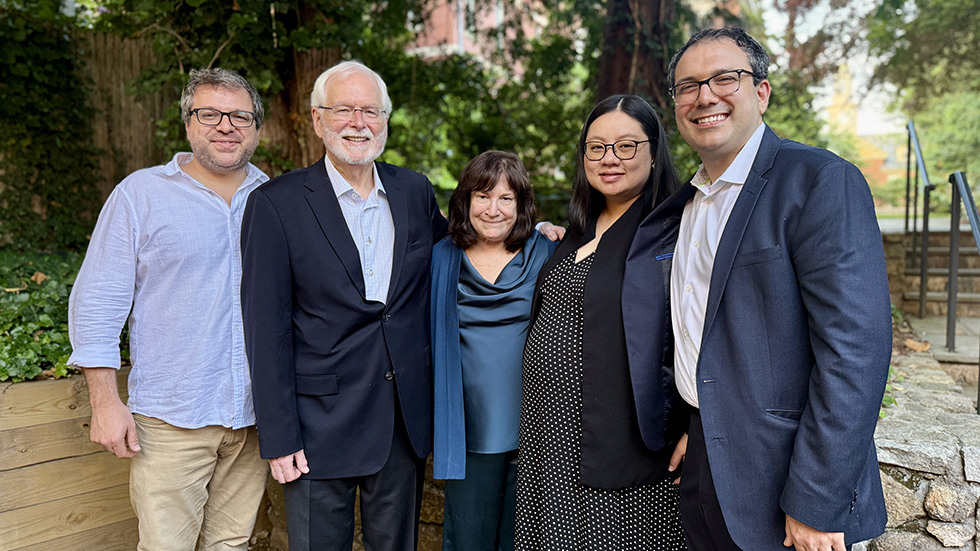
Friends, family, colleagues, collaborators, and former students and trainees came to Sayles Hall last Saturday to celebrate John P. Donoghue PhD’79, P’09, P’12MD’18, who built Brown’s brain science enterprise, mentored two generations of neuroscience talent, and helped launch the global brain-computer interface industry.
On July 1, Donoghue will become a professor emeritus after a 42-year career on campus, most recently serving as the Henry Merritt Wriston Professor of Neuroscience and professor of engineering.
Although Donoghue is retiring, he’ll continue work on BrainGate. That’s both a technology and a clinical trial, which, after launching out of Brown more than 20 years ago, has given fresh hope and freedom to people unable to move or speak due to injury, disease, or limb loss. BrainGate trial participants have used a brain implant to control devices such as computer keyboards and robotic arms using only their thoughts.
Two dozen companies in the United States, Europe, and China are now developing brain-computer interfaces based on Donoghue’s basic science. Together, these companies, including Elon Musk’s Neurolink and Sam Altman’s Merge Labs, have attracted over $3 billion in venture capital investment.
“John’s career changed the trajectory of science and medicine,” says Mukesh K. Jain, MD, dean of medicine and biological sciences, senior vice president for health affairs, and senior associate provost for life sciences. “That’s a rare thing for any of us to do.”
At the Sayles Hall symposium, and a farewell Faculty Club dinner the evening before, Donoghue drew accolades from Brown Provost Francis J. Doyle III, PhD, School of Engineering Dean Tejal Desai, PhD, and Carney Institute for Brain Science Director Diane Lipscombe, PhD, for founding Brown’s Department of Neuroscience in 1992 and then, in 1999, launching the Brain Science Program, which went on to become the Brown Institute for Brain Science, and is now the Robert J. and Nancy D. Carney Institute for Brain Science.
Carney brings together over 200 faculty members from over 20 academic and clinical units to study the brain. Carney collaborations helped build the field of computational neuroscience, advance artificial intelligence, and create brain science tools and technologies used in thousands of academic and industry labs worldwide.
“People are really proud of Brown, and know Brown, because of John’s work,” President Christina H. Paxson said as she opened the symposium. But citing honors and grants, she said, would miss the true measure of Donoghue’s impact.
“When I think about John’s work, I think about how it’s emblematic of great science,” Paxson said. “It happens because of mentorship and passing down knowledge through generations and collaborations. It creates an intellectual community.”
That community was widely represented at Sayles, where trainees and colleagues from around the world presented their research and shared stories about their mentor and friend.
They included Leigh Hochberg ’90, MD, PhD, the L. Herbert Ballou University Professor of Engineering and a professor of brain science at Brown, and the Cote Family TGS Endowed Chair in Neurotechnology at Mass General Brigham. Donoghue was Hochberg’s honors thesis adviser at Brown and a member of his PhD thesis committee at Emory University. Now, as colleagues, they help steer the BrainGate trial, a collaboration that includes seven academic and hospital partners from California to Texas to Rhode Island.
Mijail Serruya ’96 PhD’03 MD’05 RES’07, who gave BrainGate its name and helped Donoghue launch the startup company Cyberkinetics as a medical student, came up from Philadelphia. Pediatrician Nicole Ullrich ’90, MD, PhD, one of Donoghue’s first students in his experimental neurobiology course, came down from Boston, where she directs the neurologic neuro-oncology program at Dana-Farber Cancer Institute.
Mustafa Sahin ’88, MD, PhD, P’26, also presented. Sahin and his mentor both arrived at Brown in 1984, and Sahin was Donoghue’s very first trainee. Sahin took the legendary Neuro 001 course with Donoghue, joined his lab, and went on to enroll in his experimental neurobiology course. Today, Sahin is neurologist-in-chief at Boston Children’s Hospital, a professor of neurology at Harvard Medical School, and a molecular neuroscientist whose work sheds light on the biological basis of autism.
“John’s impact stems from a rare blend of contagious enthusiasm, curiosity, and generosity. He radiates a joy in discovery,” Sahin said. “As a mentor, he gives time and trust while upholding high standards, teaching people how to think rather than what to think. A natural connector, he builds bridges across labs and disciplines, amplifying others’ work. … That combination of enthusiasm, rigor, humility, and care explains why his influence extends far beyond the size of his lab—at Brown and across the neuroscience community.”