When natural disasters upend people’s lives, it’s usually not for the better. But Melanie Ortiz Alvarez de la Campa PhD’26 has been lucky enough to find a silver lining—twice.
In 2017 Ortiz Alvarez was one of almost 50 University of Puerto Rico students who transferred to Brown after Hurricane Maria devastated the island. Ortiz Alvarez, who had been pre-med at UPR, returned home after their sophomore year with a new career plan.
“Growing up, I thought I was going to be like ‘Bones’ on TV,” Ortiz Alvarez says. “That was my dream job. But then I came here and I did research for the first time. Like everyone says, it just kind of stuck.”
Working in the lab of Associate Professor of Molecular Microbiology and Immunology Peter Belenky, PhD, in Providence, Ortiz Alvarez discovered a natural affinity for research. “I’ve always been naturally curious, and I’ve loved asking questions and working with people, pursuing research seemed like the best of both worlds,” they say. “But really what cemented it for me was in the pandemic, when I saw the huge sacrifice that the physicians had to make.” Ortiz Alvarez, knowing their passions lay elsewhere, began applying to PhD programs; Brown was their first choice.
COVID-19 brought about another pivotal moment in Ortiz Alvarez’s life. “I’ve naturally always had a bigger interest for writing and art,” they say, but thought they had to separate those interests from their undergraduate biology studies. Then, during the pandemic lockdown, Ortiz Alvarez and some likeminded UPR classmates saw an opportunity.
“It became very, very obvious that it was necessary for scientists to communicate with the public,” Ortiz Alvarez recalls. In August 2020 they created an Instagram account, Ciencia Pa’ Todes (Science for All), to explain the science behind the virus, mRNA vaccines, and more, using illustrations, social-justice frameworks, and “colloquial Spanish—the way that people speak to us outside of the classroom,” they say.
“We got so much interest, and people flooding our DMs and our comments” to suggest other topics to cover, Ortiz Alvarez says. “We realized, hey, there’s some actual need here, and people are responding to it positively. Let’s use that to keep growing.”
In September 2021 Ortiz Alvarez returned to Providence to begin graduate studies in pathobiology. Back in Belenky’s lab, they investigated how early-life stress could impact someone’s microbiome and the development of anxiety later in life. They manipulated the microbiomes of mice to see how that might change behavior.
“We ended up finding a really cool potential new mechanism where, instead of seeing the hallmarks of barrier damage between the gut and the brain, we were seeing signs that it could be tightening,” Ortiz Alvarez says. “It’s kind of early days to make any assumptions about humans, but we’ve been putting a lot of work into understanding what’s happening in the microbiome so that we can narrow it down to a particular bacteria or molecule,” which could be a target for treatment.
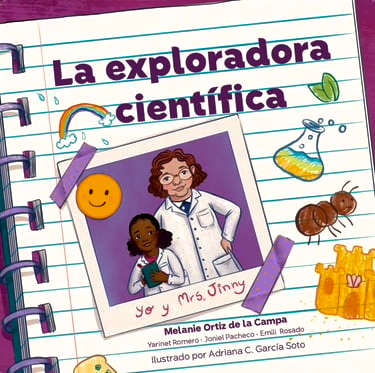
As they pursued their PhD, Ortiz Alvarez remained dedicated to science communication. With Ciencia Pa’ Todes, they participated in events when they were back in Puerto Rico, created a docuseries about intersex people, and wrote a children’s book to get Caribbean kids excited about science and give them role models. They co-founded Brown for Science Diplomacy to bring together graduate students interested in science policy, communication, and advocacy. And they helped organize Brown’s first-ever Celebration of Science, this spring, where graduate and medical students presented their research with lightning talks, posters, and art.
“Whenever there’s any sort of sci comms thing on campus, I’m there. I don’t care how much sleep I’ll be able to get, I’ll be there,” Ortiz Alvarez laughs.
Ortiz Alvarez defended their dissertation in April. “I had 100-plus people show up between in person and Zoom,” they say, including their dad, who flew in from Puerto Rico, and their mom watching back home. “She was on Zoom with my dog and her partner holding the dog up to the camera, like he’s listening too,” Ortiz Alvarez says. “I had to move the monitor a little away because I’m like, you’re making me cry right now.”
The defense was a success, not only for Ortiz Alvarez the scientist—the committee approved their dissertation—but for Ortiz Alvarez the communicator. Non-scientist friends in the audience told them afterwards, “‘I understood everything you said.’ I was so happy,” they say. “That was my main goal, since it’s open to the public, for it to be actually accessible to the public.”
Ortiz Alvarez will get to address their graduate student peers later this month, as the student speaker at Brown’s doctoral commencement ceremony. Then they return to Puerto Rico where, in addition to continuing work with Ciencia Pa’ Todes, they will begin a 10-week AAAS Mass Media Science Fellowship, reporting for the science section of El Nuevo Día. The experience should help Ortiz Alvarez decide if they want to be a full-time reporter, or explore some other area of science communication. “As long as I’m in a position where I get to talk about science with people, I think I’m going to be happy,” they say.
But first, they wouldn’t mind a bit of a break. “I’ve been doing all this for 10 years. … It has been truly nonstop,” Ortiz Alvarez says. “A little travel and time in the sun would be fun too.”