28th Annual Mind Brain Research Day showcases diverse studies
From studies on cannabis use and attitudes, to examining trauma and therapies, this year’s Mind Brain Research Day offered researchers at all levels unique insights into behavioral health and neuroscience.
The annual event, hosted March 26 by the Department of Psychiatry and Human Behavior and the Carney Institute for Brain Science, featured a poster session showcasing more than 100 different projects and keynote speaker Alyssa Rheingold, PhD, director of the Response, Recovery & Resilience Division of the National Mass Violence Center. Rheingold and her team worked closely with faculty and staff to advise and support Brown’s recovery work following the senseless Dec. 13 shooting on campus, and her presentation delved into different aspects and definitions of resilience in the wake of similar violence.
Rheingold herself confronted a tragedy in her community in 2015, with the shooting at Emanuel African Methodist Episcopal Church—known as Mother Emanuel—in Charleston, SC, where she lived. She reflected on her time working in response and recovery in the community, and her work helped inform partnerships that grew to more than 30 communities. Among the research she referenced included a February 2020 study by NMVC that surveyed nearly 6,000 adults across six communities that experienced mass violence incidents: San Bernardino, CA; Parkland, FL; Pittsburgh, PA; Virginia Beach, VA; El Paso, TX; and Dayton, OH.
“We were actually surprised by these results: nearly one-quarter of our survey respondents reported symptoms of post-tramautic stress,” she said. “That is five times higher than the national average.”
Rheingold also addressed differing interpretations of resiliency, while offering effective methods of rebuilding a sense of community. These include activities like memorials, providing access to care and victim services through local organizations, and organizing activities to provide a sense of meaning for those affected by mass violence incidents. She emphasized how the concept of hope is more than just optimism, as it can be both actionable and cultivated through different shared experiences.
“I believe, personally, that hope itself is an act of resistance,” Rheingold said.
Meet three researchers who showcased their research at this year’s poster session: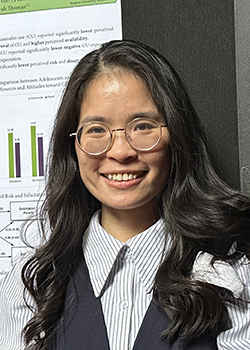
Clinical Psychology Resident: Tram Doran, PhD
Her research: Doran worked with Sarah Thomas, PhD, assistant professor of psychiatry and human behavior (research), to examine parental monitoring of the decision-making process of teenagers and cannabis. The research recruited families through hospital chart reviews, schools, and community advertising, and suggests that cannabis attitudes and beliefs may influence parental knowledge and information-seeking.
Why it matters: With other research showing how cannabis use can negatively impact adolescents, studies like Doran’s demonstrate the importance of intervention efforts on behalf of parents. This will require stronger parent-adolescent communication methods. “Parents still have a role in being more active in the way that they inform their kids about cannabis,” she says.
Postdoctoral Research Fellow: Jamilah George, PhD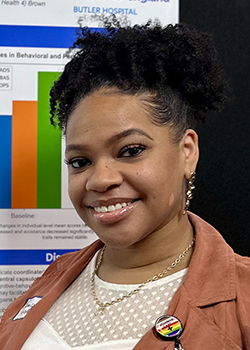
Her research: George’s study examined 15 adults with severe obsessive-compulsive disorder who underwent laser interstitial thermal therapy ventral capsulotomy and personality changes following their surgeries. The research measured pre- and post-outcomes by OCD severity, and her findings showed that post-surgical care benefits from interventions like behavioral activation and ensuring patients participate in meaningful, rewarding activities. “There’s a lot of weight we give to the power of the surgery itself, which is effective, but I think the field of psychology is coming to terms with the fact that there’s a lot of autonomy at the patient level,” she says.
Why it matters: Patients who struggle with severe OCD can be redirected to engage in positive behaviors, and research like George’s can help clinicians be more proactive in providing more effective post-surgical outcomes through behavioral interventions and empowerment. “Helping patients know that they have some level of autonomy and power, particularly when it feels like they have none, is really important,” George says.
Postdoctoral Research Fellow: Kandace Mossing, PhD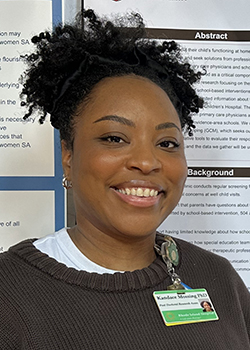
Her research: Mossing used group concept mapping to evaluate collaborative efforts between primary care physicians at Hasbro Pediatric Primary Care and school personnel at Providence-area elementary schools. Ten physicians and 10 school personnel members answered a focus prompt, asking how they can work together more effectively, and responses were organized into individual themes and categories, and ranked based on the importance and quality of the current implementation.
Why it matters: When parents are looking for support for their child, many different professionals can be involved, including primary care physicians, social workers, and psychologists. However, Mossing says these groups may lack communication and knowledge about each other’s services and roles. “I think not having that understanding from my experience causes a lot of frustration on both ends. The ultimate goal that both want is to be able to help support kids and their families in an effective way,” she says.
2026 Mind Brain Research Day Award Winners
Diversity Research Award
1st place: Mitali Temurnikar
"I wanna go home": Understanding Psychological Safety in Pediatric Inpatient Psychiatry
2nd place: Kayla Ford
A Review of NIH-Funded Projects and Randomized Controlled Trials focused on Justice-Involved Youth with Trauma-Related Experiences and Concerns
Undergraduate Student Award
1st place: Julianna Chang
Investigating TREX1 as a mediator of neuroinflammation in tauopathy
2nd place: Milidu Jayaweera
Deep Learning-Based Classification of Small Subcortical Infarcts by Etiology using Convolutional Neural Networks
Graduate/Medical Student Award
1st place: Reeya Patel
Young Children with ODD and Anxiety: Examining Profiles of Emotional, Cognitive, and Behavioral Functioning in Clinically Referred Preschoolers
2nd place: Ruixiang Li
Neural representations are separable under altered geometric contexts
Research Assistants/Staff Awards
1st place: Zhangshen (Johnson) Li
Genetic perturbation underlying a novel autosomal recessive intellectual disability syndrome disrupts progenitor mitosis and cortical neurogenesis
2nd place: Brian Gully
A Qualitative Analysis of Engagement With Existential Themes During MDMA-Assisted Therapy as a Predictor for Treatment Outcomes in Veterans with Co-Occurring PTSD and AUD
Clinical Psychology Residents Awards
1st place: Ami Ikeda
Day-Level Associations Between Cannabis Use and Sleep During Pregnancy
2nd place: Tram Doran
Cannabis Attitudes and Parental Monitoring in Parent-Adolescent Dyads
Postdoctoral Fellows Awards
1st place: Alexis Adams-Clark
Sexual identity Differences in Protective Dating Strategies, Resistance Self-Efficacy, and Psychological Barriers to Resistance
2nd place: Katie Ingram
In what ways did Youth Advisory Board feedback shape an EMA protocol?
Medical Residents/Fellows Awards
1st place: Julia Brekke-Riedi
Prenatal Major Depressive Disorder Negatively Impacts Neonatal Neurobehavioral Development
2nd place: Yashwanth Lagisetty
Interactions between hippocampus and cortex during replay facilitates reward predictive state abstractions